
The Pythagoras Cup
The Pythagoras Cup Read More »


Talking to Aliens With Wheat In 1784, a seven-year-old German child began elementary school. During a mathematics lesson, the child’s teacher asked the class to sum all the integers from 1 to 100. As the other students slogged through the calculations, the young Johann announced the answer to his instructor: 5,050. The teacher was astonished. How
Talking to Aliens With Wheat Read More »

Lady Tasting Tea A statistician, a biochemist, and a phycologist walk into a teahouse… This setup sounds like the start of a science joke. Instead, it’s a real-life scenario that showcased a potential superpower (using the term lightly) and set the stage for modern statistics. In the early 1920s, a phycologist – someone who studies

Fibonacci, Da Vinci, and a Tree Walk into a Bar written by Deborah S. And Da Vinci said, “Hey, Tree, it looks like the cross-sections of your branches sum to the cross-section of the trunk!” Then Fibonacci said, “Hey, that sounds familiar…” The tree reacted, “Well, of course, it’s not like I want my branches
Fibonacci, Da Vinci, and a Tree Walk into a Bar Read More »

The Golden Ratio and Leaves written by Deborah S. In our previous article, we learned about the Fibonacci Sequence. Today, let’s discuss another mathematical concept that is lesser known, yet also intricately linked: the Golden Ratio. Just as you may have heard of π (pi), which is equal to 3.14159…, and perhaps another constant, e, which
The Golden Ratio and Leaves Read More »

Fibonacci and Trees written by Deborah S. 1, 1, 2, 3, 5, 8, 13, 21, 34, 55, 89, 144… You may recognize the numbers above as the famous Fibonacci Sequence. Developed by Leonardo Bonacci – that’s right, his name is not Fibonacci; Fibonacci is short for filius Bonacci, which means “son of Bonacci,” and was applied by historians to distinguish this
Fibonacci and Trees Read More »
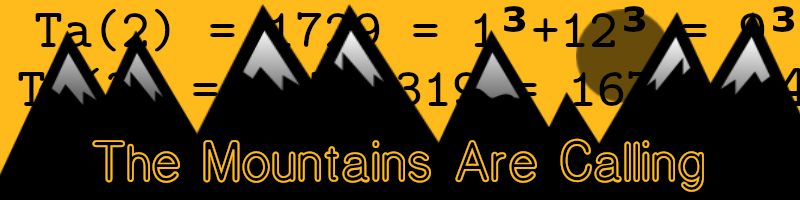
Taxicab Numbers Every positive integer was one of his personal friends. — G.H. Hardy In 1913, a mathematical prodigy from India, named Srinivasa Ramanujan, started to mail formulae and conjectures to British mathematicians. Ramanujan had largely self-taught himself numbers, as he surpassed all possible educational opportunities at a young age. By 11, two university students who

Chladni Plates by Deborah Stout I recently watched The Rings of Power, the prequel series to The Lord of the Rings. As the first episode fired up, the opening sequence rolled and I saw something that was only recently familiar to me. A still from the opening credits of The Rings of Power For the last several

The Countess of Lovelace The Hallowed Halls of Woman Crush Wednesday today garner a new occupant, in the form of one of history’s intriguing confluences of art and science. Few genealogies intersect in a more intriguing way than that of Ada Lovelace, an English mathematician revered by computer programmers. Born on 10 December 1815 in
The Countess of Lovelace Read More »

Pi Day Much of the world at large renders dates with a method that appears alien to many Americans: DD/MM/YY. This approach avoids many ambiguities and, if we’re being honest, is most likely the superior technique. At least one indisputable data point in the date format wars, however, falls squarely in favor of the