Kuun silta kromikeltainen käy ylle kylmäin vesien ja jäisten kaislarantain. Sen sillan ääriä ei näy. Yön tyhjyyteen sen holvi käy mun uniani kantain.
–Aaro Hellaakoski, “Erojaiset”
Moonglade is a nearly perfect poetic word. It rolls off the tongue melodically and marries two vivid images, conjuring a magical amalgamation.
The English word “glade” today refers to “an open passage through a wood or a grassy open or cleared space in a forest.” It sits squarely next to phrases that describe meadows, which leads to the term “everglade,” those marsh meadows that seem to stretch to infinity, or, at the very least, permanently remain meadows.
But “glade” didn’t always refer simply to an open space; it also implied a sense of brightness. Archaic usages include “a gleam of light,” “a bright patch of sky,” and “the bright space between clouds.”
The latter definitions also point to the word’s employment to describe forms other than forests and meadows. Glades could also occur in water, ice, and snow.
And these antique denotations finally bring us to our term.
A moonglade - photo by Frokor
A “moonglade” is an elongated reflection of Luna on a body of water.
Other English phrases include “moonpath” and “moonwake.” To my ear, the former suffers slightly from a potential association with the Moon’s arc through the sky. “Wakes” maintain a strong connection to the water, though they can elicit the notion of movement, too.
A few foreign phrases seem to nail the visual wonder.
Swedish has mångata, which translates to “Moon street.” The Finnish tongue includes the word kuunsilta, meaning “Moon bridge.”
These terms create imagery that can function on literal and metaphorical levels. They bridge the science of optics – the light forms a roadway from the viewer to the Moon – and the symbolism of fantastical journeys.
For example, in 1921, the Finnish poet Arlo Hellaakoski wrote Elegiasta oodiin (roughly, From Elegy to Ode). In the collection is “Erojaiset,” which translates to “Farewells” or “The Parting.” A snippet from this poem in English:
A chrome-yellow moon bridge arches over the cold waters and icy, reed-fringed shores. The ends of that bridge cannot be seen. Its arch passes into the emptiness of night, carrying my dreams.
The speaker has gathered his old ambitions in cups to dump into the sea. The physical light – kuunsilta – forms a bridge on which the dreams cross into the nighttime abyss forever.
Russian has the phrase lúnnaya dorózhka, meaning “Moon road.” In Turkish, yakamoz sometimes refers to a moonglade, though it also describes phosphorescence in water. A better analogy might be gümüşservi, which equates to “silver cypress,” describing the color and the way the path sometimes mimics the shape of a cypress tree.
Though “moonglade” is a gorgeous word, the notions of connection implied in these non-English forms burst with the holy poetic duopoly of material and metaphor.
Steamship on a moonlit night by Ivan Konstantinovich Aivazovsky
Kuunsilta, Olavinlinna Castle - photo by Ultsi
Of course, light bridges don’t need to come from the Moon.
After all, moonlight is really sunlight.
Scientists sometimes call the phenomenon a “glitter path” or “glitter pattern.” The paths are composed of single points, or “sun glints,” that create the illusion of a continuous form. For a moonglade to form, the water cannot be smooth. Ripples or turbulence create “wrinkled” or shifting glints that can appear to our eyes as a solid pattern.
They can transpire during the day thanks to the Sun, but they can also happen with non-natural light sources, such as streetlights. Astronauts can even see it from lofty heights!
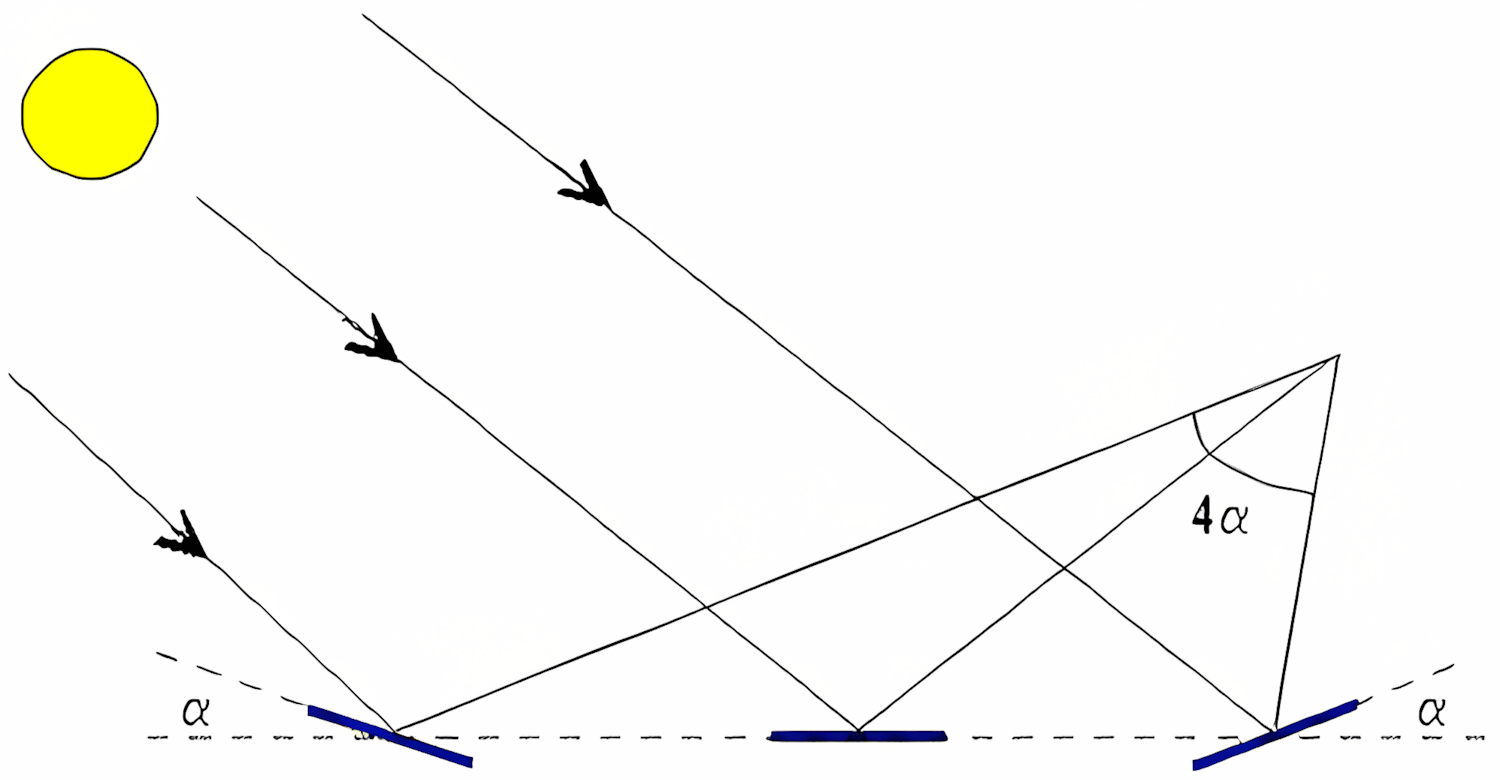
The optical geometry of glitter paths - Joseph A. Shaw/NOAA
The Sun creating a glitter path - photo by Joseph A. Shaw
Sunglint satellite in the Aegean - NASA
For some reason, the lunar form of glitter paths seems to capture our imaginations more than daytime versions.
Sun bridges formed by the rising or setting star are certainly breathtaking, but perhaps the presence of light during moments when we expect darkness allows for a more powerful image.
During night, the appearance of a light bridge, leading somewhere mysterious, packs not only the combination of ethereal and concrete, but also the surprising, binary mix of day and darkness. A moonglade, a mångata, or a kuunsilta permits us to see things we normally cannot, and go places we struggle to fathom.
No matter where the metaphor leads, the Moon’s bridges certainly are resplendent!