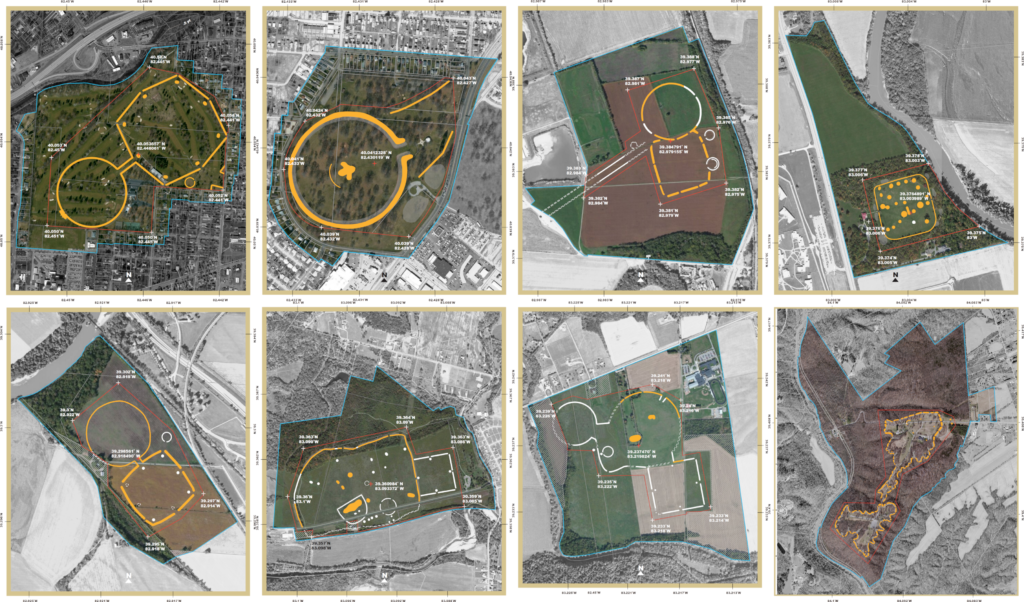
These emblematic wonders are recognized by the United Nations Educational, Scientific and Cultural Organization as World Heritage Sites; they are landmarks and areas so culturally significant that they warrant international legal protection.
Nearly any universally famous monument or park of ecological renown resides on UNESCO’s list of World Heritage Sites.
The United States has 26 Sites, but many of them also serve as National Parks. The traditional view overlooks cultural creations in the New World. As a nation, America is too young to contain a slew of human-made monuments of significant notoriety. Only a smattering – the Statue of Liberty, Independence Hall, and some Frank Lloyd Wright houses, for example – have earned a spot on the list.
The Indigenous peoples of the Americas did not usually keep written records, and they lived in places humid enough to be unforgiving to things they crafted.
Still, the pre-European societies did leave lasting monuments, written directly onto Earth. If Egypt is the land of pyramids, Europe of cathedrals, and China of Great Walls, North America might be the land of earthworks. Hundreds of thousands of mounds rose from American soil, tracing constellations as vast as those in the firmament.
But, as Americans moved westward, they did so with the notion that Indigenous people were incapable of worthwhile turns of civilization. Most Native American monuments were destroyed, either because the land was more highly prized for other uses or because they were simply not valued.
Thankfully, a change of perspective flits about. What we once perceived to be in the way, we now begin to recognize as genius, worthy of preservation. In Ohio, perhaps the epicenter of moundbuilding in America, a network of earthworks has joined the pantheon of Petra and the Colosseum as a UNESCO World Heritage Site.
World Heritage Sites in the United States
Experts believe Ohio was once home to over 10,000 earthworks.
The state has 88 counties, with an average area of 464 square miles (1,200 square kilometers). If all the mounds had been distributed evenly, each county would have more than 113; every four square miles, you’d encounter earthworks.
The scope of such a network is staggering.
In 1848, Ephraim G. Squier and Edwin H. Davis published a sweeping survey of America’s mounds for the Smithsonian Museum, called Ancient Monuments of the Mississippi Valley. The publication was the Smithsonian’s first ever, granting credence to the grandeur and importance of the earthworks.
Since then, over 90% of the earthworks have been destroyed, erased for farmland or development, an incredible loss of engineering brilliance.
Who were the people who molded 10,000 mounds in Ohio?
The ranges of prehistoric cultures in the Ohio region - graphic by Heironymous Rowe
Because of the lack of written records, we don’t know what the builders called themselves.
Further, Native American civilizations weren’t eternal or monolithic. Sometimes groups migrated; sometimes one culture sent another packing. Historians cannot definitively connect the peoples who inhabited a location before European contact to any current Indigenous tribe.
So, we have to refer to the cultural waves with general names that wouldn’t have any connection to the people at the time.
Ohio’s moundbuilders appeared in three phases. These stages might have been natural progressions of the same groups, or they could have been completely separate cultures. We simply do not know.
The first were the Adena, named for the moniker given to a mound in Chillicothe, Ohio, by an early governor of the state, Thomas Worthington. The Adena thrived between 500 BCE and 100 AD/CE. Their mounds tended to be conical. The smaller ones could be 20 feet (6 meters) in diameter, but the biggest reached 300 feet (91 meters).
Only a few of the more prominent Adena mounds survive, including the Miamisburg Mound, which is 65 feet (20 meters) high and 800 feet (240 meters) in circumference.
The Adena Mound before it was excavated - photographer unknown
Miamisburg Mound, the largest conical mound in Ohio - photo by Greg Hume
The second wave came from the Hopewell Culture.
These people stretched over large portions of the North American continent between 100 BCE and 500 AD/CE.
The Hopewell were geniuses of moundbuilding. Out were the conical structures of the Adena; in were precise geometric complexes and celestial observatories or clocks.
Though the Hopewell tradition ranged from Canada to the Gulf, from nearly the Atlantic to the Rockies, Ohio seemed to be the center of their universe. In Newark, they constructed what we have previously called the American Stonehenge, the Ocatagon Mound. This massive marvel could fit four Roman Colosseums within its angles, but it’s more than a mere polygon. The Octagon serves as a lunar clock, matching precisely the 18.6-year cycle the Moon traces through the sky. Stand on Observatory Mound at the Octagon during the Major Lunar Standstill, and you can watch the Moon rise through a tight earthwork passageway.
As incredible as the Octagon is, it was just a small cog in a larger machine known as the Newark Earthworks, the world’s largest group of geometric mounds. There’s also the Great Circle, larger than Ohio Stadium and Stonehenge times eight. When Squier and Davis encountered the array, it covered 4.5 square miles, included a massive square, and was connected by “roads” that appeared to guide visitors from one part of the apparatus to another.
Unfortunately, like the rest of Ohio, we lost nine-tenths of the Newark Earthworks to development. The Wright Square is nearly gone, as well as the passageways and many of the smaller geometries. Miraculously, the Octagon and the Circle remain virtually unchanged.
Squier and Davis' map of the Newark Earthworks
How the Major Lunar Standstill would appear at the Octagon, the Moon's northernmost maximum rise - photo from Hopewell Ceremonial Earthworks Organization
The Newark Earthworks seem to have been a cultural place of pilgrimage for the Hopewell. Artifacts from all over the continent appear in mounds there, offerings from the Upper Peninsula to the oceans to Yellowstone.
The Newark system wasn’t a standalone monument, though.
Hopewell constructions dot the Ohio landscape. Other notable creations include the Hopeton Earthworks, Mound City, High Bank Works, Seip Earthworks, the Hopewell Mound Group, and Fort Ancient. Together with the Newark Earthworks, this grouping comprises the newly created Hopewell Ceremonial Earthworks UNESCO World Heritage Site.
Designated in 2023, the earthworks now receive international legal protection and a prestige that will allow us to preserve and promote these spots responsibly to visitors.
Like Newark, many of the Hopewell mounds are aligned to the heavens. High Banks featured a circle and an octagon nearly identical to Newark, shifted by 90 degrees, that align with solar cycles. The two geometric earthworks are 55 miles apart, but some researchers believe a series of earthen “highways” might have connected many of the sites.
The scope of just the Newark Earthworks is hard for a human brain to comprehend. We process tall things more easily – mountains or skyscrapers, for example – than those that stretch across a plane. Standing within the octagon, it seems to extend to infinity. Yet, it was connected to the Great Circle, another structure that overwhelms our spatial abilities. These two massive mounds were part of a still larger local system. And Newark itself was likely linked to all the other UNESCO locations.
This collection’s scale is unimaginable. The Hopewell possessed the ability to conceive and engineer things of gargantuan size that corresponded to the movement of the Sun and the Moon. They matched their structures across enormous distances. Researchers believe they developed their own units (the shapes and sizes of the mounds fall within multiples of this Hopewellian unit). They carried this knowledge in an age without written records; they built these places without electricity, computers, or heavy construction equipment.
They were, unquestionably, artists of the highest caliber.
The UNESCO locations
Mound City - photo from Hopewell Ceremonial Earthworks
The moundbuilders didn’t stop at polygons and circles, though.
Across North America, they drew effigies of some important figures in their worldviews.
In Ohio, two famous illustrations are Serpent Mound and Alligator Mound.
Located in Adams County on the Ohio River, the Serpent Mound is the world’s largest slithery effigy mound. Between nine inches and three feet high, and 22 to 24 feet wide, the snake unfurls over 1,348 feet.
That’s about four-and-a-half American football fields long!
With a coiled tail and a head that appears to be eating an ovoid, the Serpent Mound is an ancient wonder.
Why isn’t this incredible earthwork part of the UNESCO World Heritage Site?
Though debate about the creators of the Serpent Mound continues to rage, experts believe the Hopewell Culture did not craft the earthwork. Evidence suggests the Adena used the location, but scientific dating seems to put the mound into the third wave of moundbuilders in Ohio, the Fort Ancient Culture. The World Heritage Site focuses on the Hopewell, so the Serpent Mound has to make do with National Historic Landmark status.
The Serpent Mound - photo by Niagara66
Serpent Mound - National Geographic
Squier's sketch of the Serpent Mound
The Fort Ancient Culture lived in Ohio between 1000 AD/CE and 1750 AD/CE. It’s important to note that the mound called Fort Ancient, part of the Hopewell Ceremonial Earthworks UNESCO World Heritage Site, was confusingly not created by the Fort Ancient Culture, but they did live near the earthworks and utilize them.
Another Fort Ancient effigy sits just miles from the Newark Earthworks. In Granville, the Alligator Mound likely served as a ceremonial location. Not as well preserved as the Serpent, the Alligator was about 250 feet long with 36-foot legs, and on a hilly platform between 150 and 200 feet high. Squier and Davis reported the mound appeared more like a lizard than an alligator, but the locals called it the latter. Archaeologist Brad Lepper believes early Europeans might have misinterpreted the Native American myth of the underwater panther, a formidable creature who, like the alligator, lurked beneath the waters.
Squier and Davis' sketch of the Alligator Mound
Part of the Alligator Mound today - photo by Niagara66
One depiction of the underwater panther - photo by Uyvsdi
A visit to the Alligator Mound displays the perils the earthworks of the Adena, Hopewell, and Fort Ancient cultures have had to endure. The Alligator remains as an outcropping amongst upscale housing in Granville. The Ocatagon in Newark, a site that would have been visible in the distance from the Alligator, famously spent more than a century as a golf course.
Losing 90% of Ohio’s moundbuilding legacy is a tragedy, and the state of some of the extant mounds is depressing.
Thankfully, as the status as a World Heritage Site indicates, we’re finally placing these monuments in their proper echelon.
The angles, curves, and animals of Ohio’s earthworks are astounding, both in physical scope and cerebral conception. The Hopewell gave us a Stonehenge; now it’s up to us to visit, learn, and protect their beautiful creations!